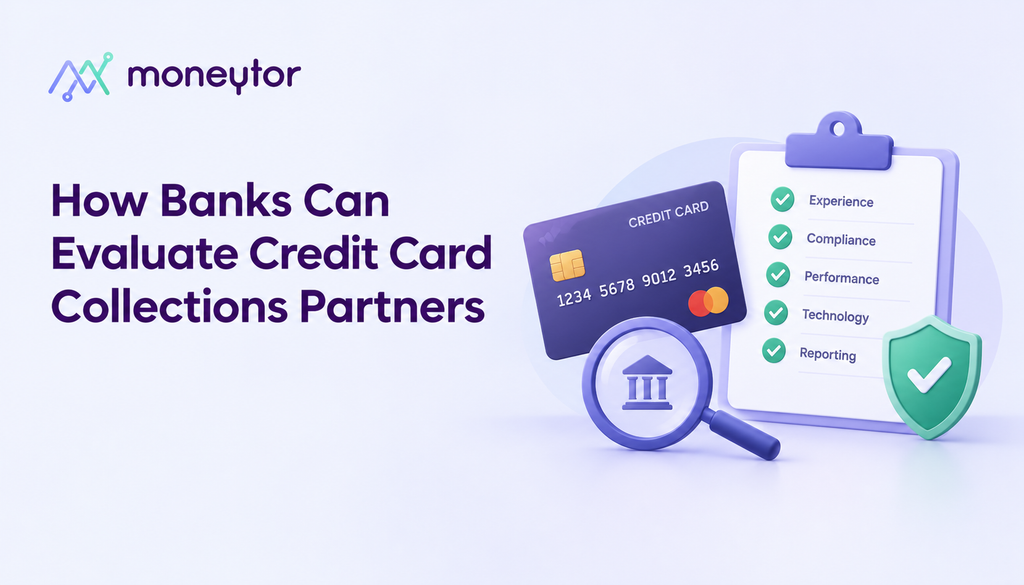
Credit card collections outsourcing can help issuers manage overdue balances and collection workloads, but the selection process must account for more than recovery performance. Banks should also evaluate customer treatment, regulatory compliance, data security and the provider’s ability to support consistent reporting.
The Reserve Bank of India’s credit card directions address third-party collection agencies, customer confidentiality, recovery-agent identification and fair collection practices. Banks should verify the latest applicable directions when assessing a provider.
Credit card collections partners help banks manage overdue card balances, organise recovery operations and monitor delinquent accounts. For credit card issuers, selecting the right partner is an important operational decision that can influence recovery performance, customer experience, compliance and collection costs.
A suitable credit card collections agency should do more than conduct follow-ups. It should demonstrate relevant portfolio experience, transparent reporting, secure information handling, trained personnel and the ability to work within the bank’s collection policies.
For heads of collections, retail lending leaders, risk teams and credit card portfolio managers, the evaluation process should focus on measurable performance and responsible recovery practices. This guide explains how banks can assess providers, compare service models and establish an accountable collections partnership.
What Is a Credit Card Collections Agency?
A credit card collections agency is a third-party service provider engaged to support the recovery of outstanding credit card dues under an agreed arrangement with a card issuer.
Depending on the engagement, the agency may support account follow-ups, delinquency management, collection operations, resolution tracking and portfolio reporting. The bank defines the authorised scope of work and retains appropriate oversight of the activities performed on its behalf.
Credit card debt collection services may include:
- Early-stage collections: Supporting follow-ups for accounts that have recently become overdue.
- Delinquency management: Managing assigned accounts according to their overdue status and recovery requirements.
- Late-stage collections: Supporting authorised recovery activities for accounts with longer-standing arrears.
- Account resolution tracking: Recording collection outcomes, payment updates and unresolved cases.
- Portfolio reporting: Providing information on recovery performance, operational costs and compliance exceptions.
The scope should reflect the bank’s portfolio, risk policies and applicable regulatory requirements.
Why Banks Need to Evaluate Credit Card Recovery Partners Carefully
Credit card portfolios can contain accounts with different outstanding balances, repayment histories and delinquency stages. Banks therefore need collection processes that reflect portfolio requirements while maintaining consistent customer protections.
Choosing a provider based only on its quoted fee or claimed recovery rate can overlook important risks.
A structured evaluation helps banks determine whether a provider can:
- Support the required volume and categories of accounts.
- Work within established collection policies and escalation procedures.
- Supply accurate, timely and reconcilable performance reports.
- Protect confidential cardholder information.
- Maintain appropriate staff training and quality monitoring.
- Support measurable recovery objectives without compromising customer treatment.
The objective is to select a partner that fits the bank’s operational requirements and governance framework, not simply the provider offering the lowest price.
8 Criteria for Evaluating Credit Card Collections Partners
1. Experience with credit card portfolios
Credit card collections have specific operational requirements. Banks should assess whether a prospective provider has experience managing overdue card balances and working with the issuer’s collection processes.
Ask providers to explain their experience across different delinquency stages, account volumes and portfolio types. Request references or documented evidence where available.
Any reported recovery results should include the measurement period, portfolio characteristics, calculation methodology and relevant limitations. This makes comparisons more meaningful and reduces the risk of relying on unsupported claims.
2. Recovery performance and measurable outcomes
A credit card collections partner should be able to explain how it measures and reports performance.
Banks should establish a baseline before assigning accounts and agree on the metrics used to evaluate results.
| Metric | What the bank should evaluate |
| Recovery rate | Amount recovered relative to a clearly defined eligible balance |
| Resolution rate | Percentage of assigned accounts reaching a defined resolution status |
| Cost per recovery | Programme costs compared with the amount recovered |
| Delinquency movement | Changes in overdue account distribution across defined stages |
| Contact effectiveness | Outcomes from documented collection interactions |
| Compliance exceptions | Complaints, policy breaches and other recorded exceptions |
No single metric tells the whole story. A provider with a higher reported recovery rate may also have higher costs or a different portfolio mix. Banks should compare like-for-like account segments and reporting periods.
3. Regulatory compliance and customer protection
Compliance is a critical part of credit card collections outsourcing.
The RBI’s credit card directions require issuers to ensure that third-party collection agencies protect customer confidentiality and follow applicable fair recovery practices. They also address the identification of recovery agents and safeguards against intimidation or harassment.
Before appointing an agency, banks should evaluate:
- Documented codes of conduct and staff training.
- Background verification and personnel authorisation processes.
- Procedures for handling complaints and escalation requests.
- Controls over collection communications and contact practices.
- Quality assurance, audit access and compliance reporting.
- Processes for identifying and correcting inappropriate conduct.
Banks should also review the applicable RBI directions and their internal policies when defining the provider’s responsibilities.
4. Technology and reporting capabilities
Reliable reporting allows banks to assess recovery activity and identify operational gaps.
Evaluate whether the agency can provide account-level updates, collection outcomes, reconciliation records and portfolio summaries in the required format. If integration with internal systems is needed, confirm the technical requirements, update frequency and responsibility for resolving data discrepancies.
Technology should improve visibility into collection operations rather than create additional manual work for the bank.
5. Data security and confidentiality
Credit card collection operations involve confidential customer and account information. Banks should verify that a provider uses suitable controls to restrict access and prevent unauthorised disclosure.
Due diligence should cover role-based access, secure data transfers, staff access management, incident reporting, data retention and secure deletion. The agreement should specify permitted uses of information and the bank’s audit rights.
The provider should receive only the information necessary to perform its authorised duties.
6. Commercial terms and cost transparency
Banks should understand the full cost of the proposed arrangement before signing a contract.
Potential models include fixed service fees, account-based charges, commission-based compensation and other mutually agreed structures.
The evaluation should clarify:
- How fees are calculated.
- Which accounts and activities are covered.
- How recoveries are attributed and reconciled.
- How disputed calculations are resolved.
- Whether additional charges apply to specific services.
- How performance and contractual termination are handled.
A lower headline fee does not automatically mean a lower total cost. Banks should assess cost alongside verified recovery outcomes, service quality and oversight requirements.
7. Operational capacity and scalability
The agency should have sufficient trained personnel and operational capacity to manage the assigned portfolio.
Banks should assess staffing, training, supervision, business continuity and the ability to accommodate changes in account volumes. They should also establish what happens if service levels deteriorate or the contract ends.
These checks help ensure that a collections programme remains manageable as portfolio requirements change.
8. Customer experience and reputation management
Collection activities can affect the issuer’s reputation. Banks should evaluate how providers monitor call quality, investigate complaints and address conduct issues.
The RBI has emphasised that regulated entities remain responsible for the actions of recovery agents engaged on their behalf. Its directions prohibit intimidation and harassment in debt collection.
Banks should therefore review complaint trends, staff training, quality monitoring and corrective action procedures as part of ongoing vendor management.
Comparing Credit Card Collections Outsourcing Models
Banks can choose different engagement models depending on their internal capabilities and collection requirements.
| Model | How it works | Key consideration |
| In-house collections | The bank manages collection operations internally. | Staffing, infrastructure and management costs |
| Outsourced collections | A third party handles specified collection activities. | Vendor oversight, service quality and compliance |
| Commission-based partnership | Compensation follows agreed commercial terms, potentially linked to verified recoveries. | Attribution, reconciliation and fee calculations |
| Hybrid collections | Internal teams and external partners handle different activities or account segments. | Clear responsibilities and consistent reporting |
A hybrid model may suit banks that want to retain direct control over certain account categories while engaging external support for selected portfolios. Other banks may prefer a more extensive outsourcing arrangement.
The right choice depends on the bank’s strategy, operational readiness, risk requirements and ability to monitor the engagement.
Questions Banks Should Ask Before Selecting a Partner
A consistent evaluation process makes it easier to compare credit card recovery partners.
Banks should ask prospective providers:
- What experience do you have with comparable credit card portfolios?
- How do you calculate and verify recovery performance?
- What reporting and reconciliation capabilities do you provide?
- How do you train, supervise and monitor recovery personnel?
- What controls protect confidential customer information?
- How are complaints, disputes and compliance incidents escalated?
- How are service fees calculated and recovery outcomes attributed?
- Can you provide documented references or verified performance evidence?
Responses should be supported by documentation wherever possible. Banks should record their evaluation criteria and apply them consistently across shortlisted providers.
How to Establish an Effective Collections Partnership
Once a provider has passed due diligence, the bank should establish a clear operating framework.
Define the scope. Specify eligible accounts, authorised activities, responsibilities and exclusions.
Agree on performance measures. Document baselines, metric definitions, reporting periods and review frequency.
Establish governance controls. Define compliance monitoring, complaint handling, data access, audit rights and escalation procedures.
Monitor results. Review recovery outcomes, operating costs, account resolution and compliance indicators against the agreed framework.
Improve or adjust the programme. Use documented findings to address performance gaps, revise workflows or reassess the partnership when required.
A limited, clearly defined programme may help the bank validate operational readiness before expanding the engagement. Any expansion should depend on verified performance, compliance and capacity.
How Moneytor Supports Institutional Debt Recovery Partnerships
Moneytor’s institutional proposition focuses on debt recovery and collections partnerships for banks and financial institutions.
For banks evaluating credit card collections outsourcing, the starting point is to understand the portfolio requirements, existing recovery processes and desired outcomes. The institution can then assess the suitability of a structured partnership based on its operational and governance needs.
Discussion areas may include:
- Credit card portfolio requirements and eligible account categories.
- Existing collections workflows and operational challenges.
- Recovery programme scope and responsibilities.
- Performance measurement and reporting requirements.
- Compliance oversight, data protection and escalation procedures.
- Commercial terms under the proposed arrangement.
The specific scope and commercial model should be agreed upon with the institution. Recovery outcomes should be assessed using verified information and clearly defined performance measures.
Are you evaluating credit card collections partners for your bank? Contact Moneytor to discuss your portfolio requirements and explore a potential debt recovery partnership.
Frequently Asked Questions
1. What should banks look for in a credit card collections agency?
Banks should assess portfolio experience, verified recovery performance, regulatory compliance, reporting capabilities, data security, commercial transparency and customer protection. Due diligence should include documented evidence and ongoing monitoring requirements.
2. What services do credit card debt collection agencies provide?
Depending on the contract, agencies may support overdue account follow-ups, delinquency management, authorised recovery activities, resolution tracking and performance reporting. The bank should define the scope and applicable controls before onboarding a provider.
3. How should banks compare credit card recovery partners?
Banks should use a consistent scorecard covering recovery performance, total cost, compliance, reporting, operational capacity and customer experience. Results should be compared across similar portfolio segments and reporting periods.
4. Is credit card collections outsourcing suitable for every bank?
Not necessarily. Suitability depends on portfolio size, internal capabilities, operating costs, risk appetite and regulatory requirements. Some banks may prefer internal collections, while others may use outsourced or hybrid models.
5. How can banks measure the performance of a collections agency?
Useful indicators include recovery rate, amount recovered, resolution rate, cost per recovery, delinquency movement and compliance exceptions. Definitions, baselines and reporting periods should be agreed upon before the programme begins.
6. What compliance requirements apply to third-party credit card collections?
Banks should verify applicable RBI credit card directions and recovery-agent requirements. Important considerations include fair recovery practices, customer confidentiality, agent identification, staff training, complaint handling and appropriate oversight.
7. Who is responsible if an outsourced recovery agent violates collection rules?
The bank remains responsible for appropriate oversight of recovery activities performed on its behalf. It should have mechanisms to investigate incidents, address complaints, take corrective action and monitor the provider’s compliance.
8. How can banks explore a credit card collections partnership with Moneytor?
Banks can contact Moneytor to discuss portfolio requirements, collection objectives, operating processes and potential commercial terms. The next step is to assess the proposed programme scope, performance measures and governance requirements.
Conclusion
Evaluating a credit card collections agency requires banks to balance recovery performance with cost, compliance, operational capacity and customer protection. A strong partner should demonstrate relevant experience, transparent reporting, secure information handling and the ability to operate within the bank’s policies.
A structured evaluation process helps issuers compare providers consistently, establish measurable expectations and maintain appropriate oversight after onboarding.
Moneytor offers an institutional starting point for banks seeking to explore debt recovery and collections partnerships. Contact Moneytor to discuss your credit card portfolio and evaluate a partnership aligned with your recovery requirements.