Non-banking financial companies (NBFCs) need reliable collection processes to manage overdue loans, monitor repayment activity and maintain visibility across their portfolios. Debt collection software for NBFCs can help organise these activities by bringing account information, collection workflows, reporting and operational controls into a structured system.
However, not every collections platform fits every lender. An NBFC managing personal loans or digital lending portfolios may have different requirements from one managing vehicle finance, business loans or other credit products.
The right software should fit the NBFC’s existing systems, support its collection strategy and provide appropriate controls over customer data and recovery activities. This guide explains the features NBFCs should evaluate before selecting a collections platform.
What Is Debt Collection Software for NBFCs?
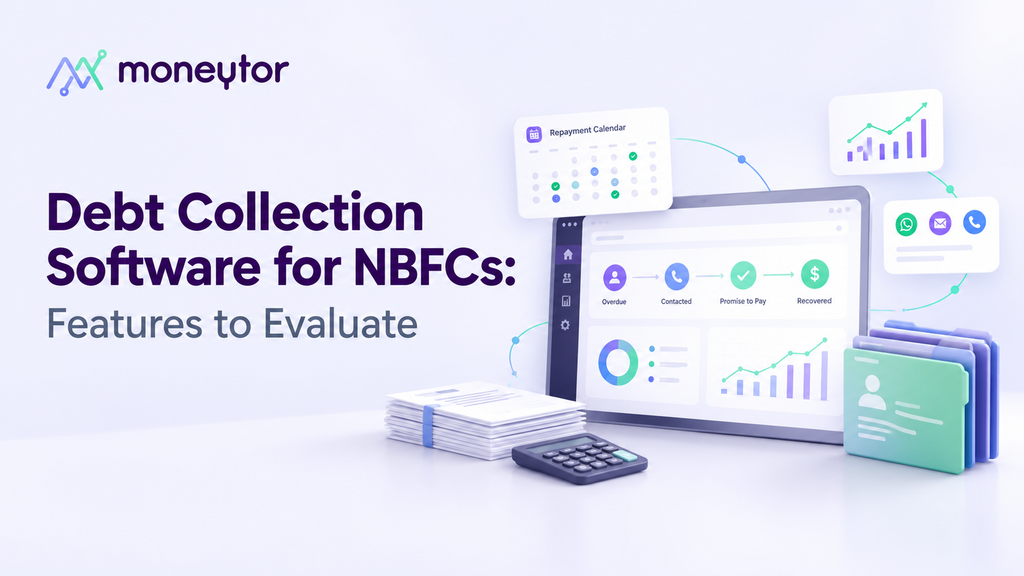
Debt collection software is a technology platform that helps lenders organise and monitor activities related to overdue loan accounts. It can centralise account information, assign collection tasks, track repayment updates and generate reports for collections and risk teams.
For NBFCs, the software may support workflows across different loan products, delinquency stages and collection channels. Depending on the platform, it may also provide integrations with loan management systems, customer relationship management tools, payment systems and reporting applications.
Common capabilities include:
- Account management: Maintain account details, outstanding balances and delinquency status.
- Workflow automation: Assign follow-ups, schedule tasks and trigger reminders based on defined rules.
- Collection monitoring: Track account activity, payment updates and resolution status.
- Portfolio reporting: Review recovery performance across products, branches or account segments.
- Compliance controls: Maintain activity records, access permissions and escalation workflows.
- System integration: Exchange authorised data with existing lending and financial systems.
NBFCs should distinguish between software that manages collection workflows and services that provide operational recovery support. These are different offerings, and the institution should evaluate each according to its requirements.
10 Features to Evaluate in NBFC Debt Collection Software
1. Centralised loan account management
A collections platform should provide a consolidated view of assigned accounts and their relevant collection information.
Collections teams may need access to outstanding balances, days past due, repayment history, previous contact outcomes and pending actions. A centralised view can reduce fragmented records and help staff understand the status of an account before taking action.
When evaluating this feature, check whether the platform supports multiple loan products, configurable account fields, reliable data updates and appropriate access restrictions.
2. Automated collection workflows
NBFC collections automation can help reduce repetitive administrative work by assigning tasks and triggering actions according to predefined rules.
For example, a platform may assign an overdue account to a collections queue, create a follow-up task or escalate an unresolved case after a specified period.
Useful capabilities include:
- Rule-based account allocation.
- Scheduled follow-up tasks and reminders.
- Escalation workflows for unresolved accounts.
- Configurable rules for different delinquency stages.
- Task completion tracking and exception alerts.
Automation should remain configurable and subject to human oversight. It should not trigger inappropriate contact or override the lender’s approved collection policies.
3. Delinquency segmentation and prioritisation
Not every overdue account requires the same workflow. NBFCs should look for software that can organise accounts by days past due, outstanding balance, loan type and other relevant portfolio characteristics.
Segmentation helps managers distribute workloads and monitor different account categories.
A suitable platform should allow authorised users to define segmentation rules, update account classifications and review how workloads are distributed across collection teams.
Any automated prioritisation should be transparent, reviewable and consistent with the institution’s policies.
4. Collection performance dashboards
Dashboards help collections managers understand operational performance without relying entirely on manual reports.
Useful metrics may include:
- Amount recovered during a defined period.
- Recovery rate against a documented balance or account baseline.
- Resolution rate for assigned accounts.
- Overdue accounts by delinquency stage.
- Collection costs and productivity indicators.
- Pending reconciliation items and compliance exceptions.
The software should clearly define each metric and allow users to filter results by portfolio, branch, team and reporting period.
NBFCs should verify dashboard calculations against underlying account records before relying on them for management decisions.
5. Integration with lending and financial systems
A collections platform should fit into the NBFC’s existing technology environment.
Depending on its architecture, the institution may need integrations with a loan management system (LMS), loan origination system (LOS), customer relationship management (CRM) software, payment systems and business intelligence tools.
Evaluate whether the software supports documented APIs, secure data transfers, reliable synchronisation and reconciliation of mismatched records.
The implementation team should also clarify integration costs, maintenance responsibilities and procedures for handling system outages.
6. Communication and channel management
NBFCs may use approved communication channels to send repayment reminders, record collection interactions and manage follow-up tasks.
Depending on the platform, these workflows may include SMS, email, telephone integrations or other authorised channels.
The key evaluation questions are whether communications can be logged, permissions can be controlled and customer contact preferences and applicable restrictions can be respected.
Communication automation should not encourage excessive contact, misleading messages or practices that violate applicable requirements.
7. Data security and role-based access
Loan collections software may process confidential borrower information and financial records. Data security must therefore be a core selection criterion.
Evaluate the availability of:
- Role-based access and user permissions.
- Multi-factor authentication, where appropriate.
- Encryption for data in transit and at rest.
- Audit logs for important user and system activities.
- Backup and disaster recovery arrangements.
- Security incident reporting and response procedures.
- Data retention, deletion and export controls.
The Reserve Bank of India’s IT outsourcing directions require applicable regulated entities to assess service-provider risks, including information security, data protection, business continuity and access to records. NBFCs should confirm which current requirements apply to their proposed software arrangement.
8. Compliance monitoring and audit trails
NBFCs need visibility into collection activities and the ability to investigate exceptions.
Software should make it possible to review relevant activity records, user actions, account updates and escalation history. Where required, the platform should support evidence retention and authorised audit access.
Before implementation, establish how the software will support the NBFC’s internal policies, complaint management and applicable RBI requirements.
Software alone does not guarantee compliance. The institution remains responsible for suitable governance, oversight and controls over its collection operations.
9. Scalability and operational reliability
A platform that works for a small portfolio may not meet the needs of a growing NBFC.
Evaluate expected account volumes, concurrent users, reporting workloads, system availability and the provider’s ability to support business growth.
Ask vendors about service-level agreements, technical support, backup arrangements, recovery testing and business continuity plans.
The institution should also establish how it can retrieve its data and transition to another provider if the contract ends.
10. Reporting flexibility and management insights
Different teams need different views of collection performance. Frontline managers may need task-level reports, while senior leadership may require portfolio-level summaries.
A suitable platform should provide configurable reports, downloadable records where authorised and consistent definitions for key performance indicators.
More advanced analytics may identify changes in delinquency patterns or highlight accounts requiring review. However, predictive scores and automated recommendations should be assessed for accuracy, explainability, data quality and suitability for the intended use.
Comparison Table: Features NBFCs Should Prioritise
| Feature | Why it matters | What to verify |
| Account management | Consolidates loan information | Data accuracy and account history |
| Workflow automation | Reduces repetitive tasks | Configurable rules and escalation controls |
| Delinquency segmentation | Organises recovery workloads | Flexible, reviewable segmentation |
| Performance dashboards | Improves portfolio visibility | Defined metrics and traceable calculations |
| System integration | Connects existing applications | API support and reconciliation |
| Communication management | Records collection interactions | Approved channels and contact controls |
| Data security | Protects borrower information | Access controls, encryption and audit logs |
| Compliance monitoring | Supports oversight | Activity records and exception reporting |
| Scalability | Supports portfolio growth | Capacity, reliability and service commitments |
| Reporting and analytics | Supports management decisions | Custom reports and reliable data exports |
NBFCs should evaluate these features against their actual operational requirements rather than selecting a platform solely because it offers the largest number of functions.
How to Evaluate NBFC Debt Collection Software Vendors
A structured evaluation process helps lenders compare platforms consistently.
Step 1: Define operational requirements
Document the loan products, account volumes, delinquency stages, workflows and reporting requirements the software must support.
Step 2: Check integration and data readiness
Identify the source systems, required data fields, update frequency and reconciliation processes. Confirm that the proposed integration is technically feasible.
Step 3: Conduct a controlled demonstration
Ask shortlisted vendors to demonstrate real workflows, such as assigning an overdue account, recording a follow-up, escalating a case and generating a portfolio report.
Step 4: Review security and compliance
Assess security documentation, audit capabilities, data handling, service-provider responsibilities and business continuity arrangements.
Step 5: Compare total cost of ownership
Consider licensing or subscription charges, implementation, integration, training, maintenance, support and future scaling costs.
Step 6: Run a pilot and validate results
Where practical, test the platform with a defined portfolio or team. Compare operational performance with a documented baseline and investigate data discrepancies before expanding deployment.
How Moneytor Fits into the Institutional Debt Recovery Landscape
Moneytor’s institutional proposition focuses on debt recovery and collections partnerships for banks, NBFCs and financial institutions.
For an NBFC evaluating debt collection software, it is important to establish whether the institution needs a technology platform, an operational recovery partner or a combination of capabilities. These models serve different purposes and should not be treated as interchangeable.
Moneytor can be approached to discuss institutional debt recovery requirements and assess whether its partnership model aligns with the lender’s needs. Discussions may cover portfolio characteristics, existing collection processes, recovery objectives, reporting expectations and commercial terms.
Specific software capabilities, integrations and performance outcomes should be confirmed directly rather than assumed.
Looking to improve recovery operations across your loan portfolio? Contact Moneytor to discuss your institutional debt recovery requirements and explore a potential partnership.
Frequently Asked Questions
1. What is debt collection software for NBFCs?
Debt collection software for NBFCs helps lenders manage overdue loan accounts, assign collection tasks, monitor repayment activity and report portfolio performance. Features vary by provider, so NBFCs should assess the platform against their operational and compliance requirements.
2. Which features are most important in NBFC debt collection software?
Core features include account management, workflow automation, delinquency segmentation, performance dashboards, system integration, data security, audit trails and configurable reporting. The right priorities depend on the institution’s portfolio and collection strategy.
3. How does NBFC collections automation help lenders?
Automation can reduce repetitive administrative tasks, support timely task assignment and standardise follow-up workflows. Its effectiveness depends on appropriate rules, reliable data and oversight of automated activities.
4. Can debt collection software integrate with an NBFC’s LMS?
Some platforms support integration with loan management systems through APIs or other data exchange methods. NBFCs should verify the specific integration, synchronisation frequency, security controls and reconciliation process with the vendor.
5. How should NBFCs measure software performance?
NBFCs can assess data accuracy, task completion, reporting reliability, system availability, workflow efficiency and collection outcomes. Financial results should be measured against a defined baseline and should not be attributed to software alone without supporting evidence.
6. Is debt collection software the same as a collection agency?
No. Software provides technology to organise and monitor collection operations. A collection agency provides services under an agreed arrangement. An NBFC may use either model or both, depending on its requirements and applicable regulatory obligations.
7. What security checks should NBFCs perform before purchasing collections software?
Review access controls, encryption, audit logs, data retention, backup and recovery, incident response, contractual safeguards and vendor access to customer information. The NBFC should also verify applicable regulatory requirements for IT outsourcing.
8. How can an NBFC select the right collections platform?
Define requirements, assess integration needs, compare vendors against a consistent scorecard, review security and compliance controls, calculate total cost and conduct a pilot where practical. Document the evaluation and confirm that the platform meets the institution’s needs.
Conclusion
Choosing debt collection software for NBFCs requires a careful assessment of workflow automation, account visibility, system integration, reporting, data security and operational reliability.
The right platform should support the lender’s collection processes while providing the controls and information needed for responsible portfolio management. A structured vendor assessment, realistic pilot and clear implementation plan can help NBFCs make an informed decision.
Moneytor provides an institutional starting point for NBFCs exploring debt recovery and collections partnerships. Contact Moneytor to discuss your recovery requirements and evaluate an approach aligned with your portfolio and operational objectives.