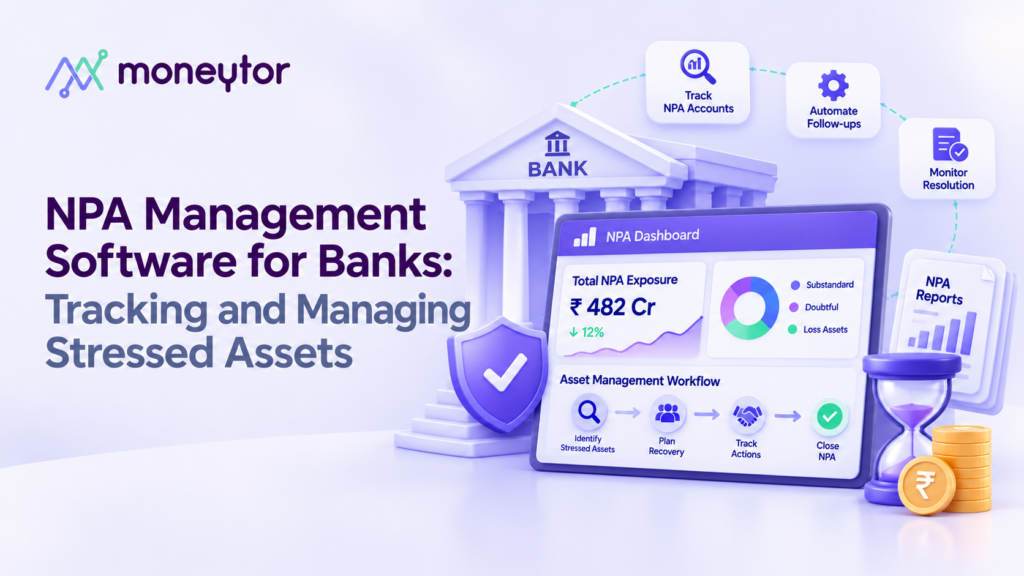
NPA management software for banks is the collections system a bank uses on accounts it already treats as stressed. It runs configurable workflows, automated communication, allocation, settlement and repayment plans the bank has authorised, and analytics on that work. A bank NPA tracking system also shows the borrower, the facility, the status the bank has assigned, and the owner of the next action. It does not decide that an account is non-performing, and it does not calculate provisions.
Non-performing asset management software is easy to over-read. Large corporate cases, security enforcement and insolvency sit with the bank’s stressed-asset and legal teams and with the prudential framework. A stressed asset management platform in the collections sense works the retail and other accounts the bank chooses to collect through a supervised path: the rule for the next step, the message or call, the person who owns it, and the payment or plan the bank has allowed.
This guide is for heads of collections and stressed-asset operations at commercial banks who are comparing that kind of system. Classification stays in the bank’s finance and credit process. The software manages the collections work that follows the status the bank supplies. What any one product includes still depends on the agreement.
What the bank classifies, and what the software tracks
Classification is a prudential job. Under the Commercial Banks – Income Recognition, Asset Classification and Provisioning Directions, 2025, updated as on 1 October 2026, a commercial bank classifies a term loan as non-performing when interest or principal remains overdue for more than 90 days. Other facilities have their own tests, including overdrafts, bills and crop loans. Those directions apply to commercial banks other than small finance banks, payments banks and local area banks. The bank’s core process applies the test. A collections screen that stamps “NPA” on its own is the wrong tool.
From 1 April 2027, those directions are replaced by the Commercial Banks – Asset Classification, Provisioning and Income Recognition Directions, 2026. They keep a non-performing classification and add an expected-credit-loss staging approach for provisioning and income. Until that date, the 2025 directions remain in force. Provisioning, income recognition and the statutory return stay in the bank’s finance systems. Collections software should read the status the bank supplies. It should not be the book of record for the provision.
The collections job is wider than a log of activity, and it still starts from the bank’s status. Once an account is in the stressed book the bank wants worked, the software has to move the case and show the work. A bank NPA tracking system in that sense holds:
- The borrower and each facility in the mandate.
- The status and stage the bank has fed, and the date that feed last refreshed.
- The team or person who owns the next step.
- Promises, disputes, complaints and stops.
- Contact and field activity the bank has allowed.
- Payments and any settlement the bank has already authorised, matched to the facility.
- A list of accounts whose status on the screen does not match the latest feed.
- The workflow for that stage: the next task, the approved template, and whether the step can run or must wait for a person.
- Allocation rules the bank can change, and the follow-up those rules produced.
- A repayment amount or a settlement the bank has authorised, including a repayment plan the bank has set.
- Portfolio lists for the segment: unassigned work, aged follow-ups, unmatched payments, open complaints and the stage mix from the bank’s feed.
If the feed and the screen disagree, contact waits until credit operations corrects the status. Acting on a stale NPA flag is an operating error, not a collections success.
Which stressed accounts belong on a collections platform
Put retail and other standardised facilities on the platform when the path is repeatable and the policy is written: personal loans, cards, consumer loans and similar accounts the bank has marked for collections follow-up, whether they are still special-mention or already non-performing.
Keep a different operating stack for work this platform should not pretend to run:
- Consortium and large corporate accounts with multiple lenders.
- Security enforcement and possession, unless the bank has a written step and an approver, and even then the legal record stays with the bank.
- Insolvency filings and tribunal matters.
- The provision, the write-off and the upgrade of the asset. Those entries are made in the bank’s prudential systems after the bank’s own tests are met. A payment on a collections case is an input to that process. It is not the upgrade.
A stressed asset management platform can still show that a retail account has been referred to the legal team, and it can stop collections contact when that happens. The referral is a status and a handoff, not a substitute for the legal file.
Features that matter for tracking
Score a product on the stressed book you will actually load. Confirm each item in a working session. Do not assume every bank receives the same set.
Central borrower and facility record. One customer, every in-scope facility, the bank-supplied status, the owner and the history. A borrower with two retail facilities is one person, so a card team and a personal-loan team do not run two silent queues.
Rules the bank writes for the stage it supplied. A newly marked account, a broken promise, a complaint and a case referred out of collections follow different paths. Automation may open a task or send a template the bank approved. It waits for a person on settlement terms, hardship and any step that touches security. The rule does not reclassify the asset.
Allocation and follow-up. Every open action has an owner and a due time. Supervisors see due work, aged work and unassigned work for the stressed segment. That is the bank NPA tracking system’s daily control, separate from the month-end classification report.
Contact on approved channels. SMS, email, WhatsApp, Telegram, calling and IVR can be used if the bank has enabled them and approved the template. Attempts, failures and replies sit on the facility. Quiet hours apply. Covered commercial banks currently restrict recovery calls before 8:00 a.m. and after 7:00 p.m. on overdue loans other than microfinance, under the Commercial Banks – Responsible Business Conduct Directions, 2025, updated as on 1 October 2026. From 1 January 2027, the Fourth Amendment limits contact and visits for covered banks to 8:00 a.m.–7:00 p.m. unless the borrower has expressly agreed otherwise, and it treats a wider set of outside parties, including business correspondents doing recovery, as recovery agencies. A complaint holds further reminders until the bank releases the case.
Payments and settlements the bank has authorised. The screen can offer an overdue amount or a settlement credit has already approved, and it can store the receipt against the facility. It cannot set a concession, a write-off, or an upgrade. Unmatched receipts stay in an exception list and off the calling queue. Finance decides what the cash means for classification.
Activity reporting for the stressed segment. Loaded accounts, status as of the last feed, owners, attempts, promises, payments, holds and mismatches, each traceable to facilities. This report supports the collections review. It is not the bank’s NPA disclosure.
Connections to the bank’s systems and providers. The core or loan system feeds status and amount due. Communication and payment providers the bank already uses can feed activity, where that is in scope. The bank needs the refresh time and the owner of a failed feed. It does not need the vendor’s internal design.
Card facilities on the same platform stay within the credit card directions, updated as on 7 March 2024: share only what collection requires, and keep card data with the issuer unless sharing is essential and permitted.
How to judge a product in a review
- Take a sample the bank has already classified, including one borrower with two facilities and one account whose status changed in the last feed.
- Check that the screen shows the bank’s status and the feed time, and that it does not invent a class.
- Walk a complaint hold, an approved template, and a payment that matches one facility and fails on a bad reference.
- Open the segment report and trace one total to the facilities.
- Ask what leaves with the bank if the contract ends: status history, notes, contact and payment references.
- Confirm the feed is operated by the bank’s asset-classification process, and that provisioning stays outside the tool.
Outsourcing the tracking system does not move responsibility. Under the Commercial Banks – Managing Risks in Outsourcing Directions, 2025, the bank, its board and senior management remain responsible for the activity and for customer information a provider holds. If a partner works the accounts, they work them on the record the bank can see.
Do not select the software because a proposal quotes a recovery rate or a reduction in provisions. Those outcomes depend on the book, the policy and the bank’s own classification. Select it because the stressed accounts you loaded are complete, current and supervisable.
How Moneytor fits a bank’s stressed-account work
Moneytor provides collections software banks use to work stressed retail credit they place in scope. The B2B technology offer is an intellectual-property licence. The bank receives a licensed copy of the product source code, deploys it in its own infrastructure, and can modify that copy for its products, workflows and systems, subject to the licensing agreement. Collection staffing, where Moneytor people contact borrowers, is a separate contract. The licence does not include that staff.
The software is for rule-based collections and digital resolution of amounts the bank has authorised. It uses the status the bank supplies. It is not the bank’s asset-classification engine, provisioning ledger, or legal case system. Modifying the source code does not move classification, provisioning or a legal filing into the collections screen.
Bring a sample of accounts your process has already marked, one two-facility borrower, the feed you would trust for status, and the workflow change you would want in the licensed copy. What is shown is the scope to agree.
Where the engagement includes them, the platform can support:
- A licensed source-code copy the bank deploys and can adapt, within the licence, to its loan feed, its products and its collection strategies.
- A central record of the borrower and each in-scope facility, including the status and stage from the bank’s feed, the owner and the history. A combined view of two facilities follows the match confirmed in that bank’s integration.
- Configurable, rule-based collection workflows for the stages the bank defines. Automation opens the task and sends the approved template. A settlement, a hardship request, a security step and a referral out of collections wait for the bank’s approver. A complaint is tracked on the facility. Any stop on later messages is a rule the bank confirms in its copy.
- Allocation and follow-up tracking the bank configures, so supervisors see due, aged and unassigned work.
- Automated communication by SMS, email, WhatsApp, Telegram, calling and IVR, on the bank’s templates and inside the hours that apply, with the attempt and the reply on the facility.
- Response tracking for promises, disputes and complaints.
- Digital resolution through repayment and settlement workflows, including a repayment plan the bank has set, for amounts credit has already authorised. Receipts post to the facility for finance to reconcile. The platform does not upgrade the asset.
- Analytics for the stressed segment: unassigned work, aged follow-ups, unmatched payments, open complaints and the stage mix from the bank’s feed, each traceable to facilities. The lists support the collections review. They are not the bank’s NPA disclosure and they are not a recovery forecast.
- Connections to the bank’s loan feed and to communication and payment providers the bank already uses, where that connection is part of the design.
Moneytor does not take the bank’s prudential classification, provisioning, or regulatory duty. The licence, any source-code changes and the facilities in scope are agreed per bank. To test the software, use moneytor.in or contact@moneytor.in and ask to load a sample status, run one approved workflow, and post an authorised payment or plan without changing the asset class.
Frequently asked questions
What should NPA management software for banks track?
The borrower, each facility the bank has placed in the mandate, and the status the bank’s process supplied. On top of that status it should run the workflow, the allocation, the approved contact, and the repayment or settlement the bank has authorised, and it should list gaps such as unassigned work and unmatched payments. It should show when its status is older than the latest feed.
Does a bank NPA tracking system classify non-performing assets?
Classification stays with the bank under the income-recognition and asset-classification directions in force. For term loans, the 2025 directions use a more-than-90-days overdue test, and other facilities have other tests. The software displays the result the bank sends. From 1 April 2027, banks move to the 2026 directions. Provisioning remains a finance process.
How is this different from a legal or insolvency system?
A collections platform tracks supervised contact and payment activity on accounts the bank has decided to work that way. Consortium cases, security enforcement, tribunal work and the provision sit in the bank’s stressed-asset and finance processes. The platform can record a referral and stop contact. It does not replace those files.
Which contact features belong on a stressed asset management platform?
SMS, email, WhatsApp, Telegram, calling and IVR, if the bank enables them, with approved templates, quiet hours, a complaint hold, and the reply stored on the facility. From 1 January 2027, covered banks apply the amended recovery-agency rules, including the 8:00 a.m. to 7:00 p.m. window unless the borrower has agreed otherwise.
Can the software approve a settlement or an upgrade?
It can route a request and, after a bank approver sets the terms, record the offer and the receipt. Upgrade, write-off and provisioning stay in the bank’s prudential process after its own tests are met.
What should a review session include?
A sample the bank has already classified, a borrower with two facilities, a status that changed in the last feed, a complaint hold, and a payment that either matches the facility or falls into an exception list. Trace one report total back to facilities.
Who is responsible if a vendor or partner handles the accounts?
The bank, its board and senior management. Outsourcing does not move the duty. The bank needs audit access, a current feed it controls, and a way to take the history back.
How can a bank review Moneytor for this tracking job?
Contact Moneytor through moneytor.in or contact@moneytor.in. Bring accounts your process has already marked, the status feed you trust, and a workflow you would want changed in the licensed source-code copy. Ask to see that workflow, an authorised repayment or settlement, and the segment lists. Confirm that the asset class does not change on the screen except from your feed.
Conclusion
NPA management software for banks is useful when it runs collections on the stressed accounts the bank has decided to work, and stays out of classification and provisioning. A sound system shows the bank’s status, then applies the workflow, the owner, the contact, the authorised repayment or settlement, and the lists a supervisor can trace. Upgrades and provisions stay in the bank’s own process.
Moneytor licenses that software as source code the bank deploys and can modify under the licensing agreement. In the agreed scope it covers rule-based workflows, automated communication, configurable allocation, digital repayment and settlement, analytics, and connections to the bank’s feed and providers. Load a sample the bank has already classified before you treat the screen as your stressed-asset book.