A retail loan collections platform is how a lender runs overdue retail credit when the book is more than one product. A personal loan, a credit card, a two-wheeler loan and a consumer-durable loan do not become overdue in the same way, and they should not share one script. They also need a borrower record that can be linked to each facility the lender decides to collect. Whether two products from two host systems resolve to that same borrower is part of the integration, and it should be confirmed before anyone relies on a combined view.
Retail lending collections software is fit for that job when each product keeps its own path, and the customer is still one person. A personal loan collections system that cannot see the card, or a credit card collections platform that cannot see the personal loan, will contact the same household twice and report two books that do not add up.
This guide is for heads of retail credit and collections at banks and NBFCs. It explains how to manage the products side by side. It is not a card-statement manual, a single-account system test, or a partner scorecard. What any deployment includes depends on the products you place in scope.
Why retail products cannot share one path
The event that starts collections is different.
- A personal loan usually starts with a missed or bounced instalment. The amount due is an EMI, a part payment, or the overdue sum of missed EMIs.
- A credit card starts from a statement. The customer may have paid something and still be short of the minimum amount due. The cycle date matters.
- A two-wheeler or consumer-durable loan is often shorter tenor, with a dealer or a field relationship still in the background. The path may include a local contact as well as a message.
- A gold loan or other secured retail facility, where you collect it on the same platform, needs a hold before anyone discusses the security. That step does not belong on an unsecured personal loan.
A retail loan collections platform stores those differences as rules on the product. It does not flatten them into one reminder.
The borrower link is the other half. Many retail borrowers hold two of these products with the same lender. The software keeps a borrower and the accounts related to that borrower. A combined view of those accounts, and a match of the same person across host systems, has to be proved on that lender’s data before the second team treats it as one conversation. A promise, a complaint or a request to stop a channel can then be read on the accounts the match has joined.
What portfolio managers need across the book
Retail portfolio management in collections is a product view and a customer view, both current.
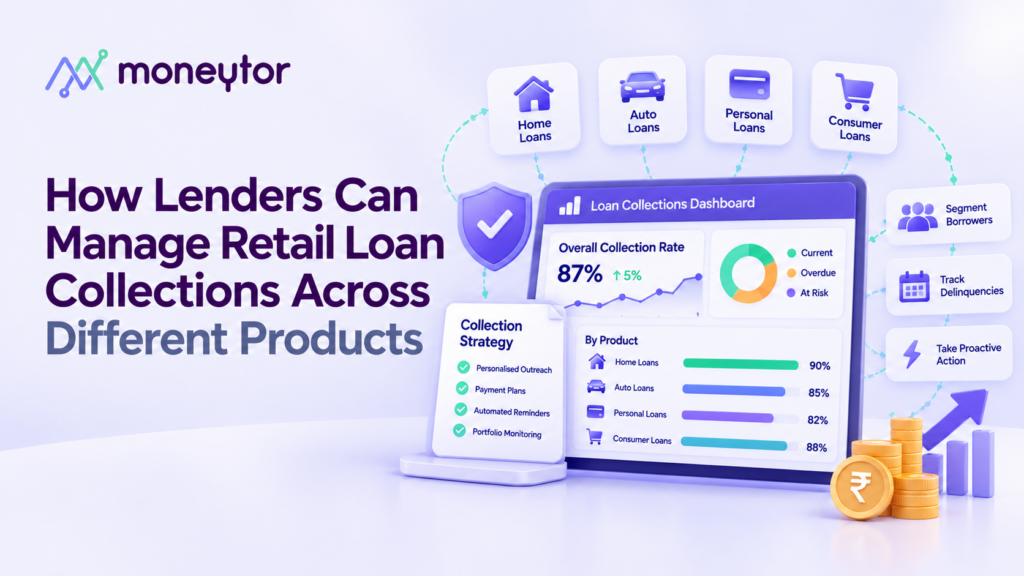
By product. Accounts loaded, stage mix, follow-ups due, follow-ups with no owner, promises due, payments posted, and payments that did not match. A personal loan collections system and a credit card collections platform can be the same software with two product settings. The numbers are read separately, because a card bucket and a personal-loan bucket are not the same portfolio.
By borrower. Where the integration has matched more than one product to the same borrower, and more than one of those accounts is in arrears, the owner of the next contact is explicit. One team speaks. The other product waits on the outcome, unless your policy says both may proceed and the customer has been told why. If the match is not confirmed, each product keeps its own owner and the teams do not assume a shared view.
By exception. Complaints, disputes, balance mismatches and settlement requests sit in lists that cut across products. A complaint on the card stops card reminders. Your rule should say whether it also stops the personal-loan reminder. Write that rule. Do not leave it to the officer on the day.
The host systems remain the source of what is due. The collections platform is the source of who is doing what. When a card balance or an EMI on the case does not match the host, that account waits.
How to set the platform up by product
Use the same building blocks, and fill them in differently.
Record. Borrower, then each in-scope facility linked to that borrower. Cross-product identity matching is checked against the host files for that lender. It is not assumed because two products share a name. Card fields stay limited to what collection of the overdue amount requires. Card issuers keep card data with the issuer unless sharing is essential and permitted, under the Credit Card and Debit Card – Issuance and Conduct Directions, 2022, updated as on 7 March 2024.
Path. For each product, name the first event, the number of attempts, the channel order, and the events that wait for a person. A bounced EMI and a short payment on a card do not need the same first template.
Queue. Allocate by product, stage, language or location if that is how the floor is staffed. A two-wheeler book with field follow-up and a card book with messages can use different owners. They share a borrower record only where the integration has matched the accounts.
Channels. SMS, email, WhatsApp, Telegram, calling and IVR are available to a product only if you enable them and approve the template for that product. A card message that quotes a statement balance should not be reused on a personal loan.
Money. Each product posts to its own account reference. A card payment and an EMI payment must not land on the wrong facility. Unmatched receipts stay off the calling queue.
Approval. Settlement grids differ by product. The platform can open the request. The approver for that product sets the terms.
Quiet hours sit in the product setting. Covered commercial banks currently bar recovery calls before 8:00 a.m. and after 7:00 p.m. on overdue loans other than microfinance, under the Commercial Banks – Responsible Business Conduct Directions, 2025, updated as on 1 October 2026. Card contact also follows the credit card directions, including identification of a recovery agent and a senior officer of the issuer the cardholder can reach. NBFCs follow the NBFC Responsible Business Conduct Directions, 2025, updated as on 1 July 2026, with a tighter window for microfinance. From 1 January 2027, covered banks and covered NBFCs take up amended rules, including contact between 8:00 a.m. and 7:00 p.m. unless the borrower has expressly agreed otherwise. See the bank Fourth Amendment and the NBFC Third Amendment. One platform can hold more than one window. Your compliance team confirms which window belongs to which product.
A practical sequence for a multi-product book
- List the products you will collect on the platform in the first release. Leave secured recovery and any product whose policy is still being rewritten off that list.
- Write a one-page path for each. First event, channels, attempt cap, hold events, payment reference.
- Define the borrower rule, after a sample match. Who speaks first when two matched products are overdue, and which stops apply to both. If the sample does not match the person across hosts, keep the products on separate owners.
- Connect each host balance and each payment reference before the second channel goes live.
- Read product reports separately for a month. Fix mismatches and double contact. Add another product only after those two are stable.
If a partner works one product, that partner uses the borrower and account record your retail head can open for the facilities in that engagement. The lender remains responsible for the activity and for customer information a provider holds, under the bank outsourcing directions, 2025 and the NBFC outsourcing directions, 2025. Confirm the chapters that apply to you.
Judge the platform on product-level completeness and, where a cross-product match has been confirmed, on whether that borrower was contacted once under your rule. Do not judge it on a blended recovery rate across products that do not behave alike.
How Moneytor handles a multi-product retail book
Moneytor provides collections software that banks and NBFCs license as source code and run for their own retail credit in arrears. Because the lender receives the source code, the product paths, allocation rules and collection strategies can be changed in that code for the products that lender actually books. A personal-loan path and a card path can be written as separate workflows. A product, a queue rule or a strategy that is specific to one institution is a source-code change for that institution, agreed in the engagement. It is not assumed to ship, unchanged, for every lender.
The software keeps borrower-account relationships: a borrower, and the loan or card accounts linked to that borrower. Showing a personal loan and a card together depends on the identity match between the host systems in that integration. Confirm the match, and what a user then sees on one screen, before the engagement promises a unified view for every product.
Some lenders also ask Moneytor to operate a product. That brief is separate from the source-code licence and from the platform setup.
Bring the two products you would go live with first, the allocation and strategy rules those products need, a sample of how the same person appears in each host, and a payment that must hit the right facility. What you see is the scope to agree. A product or a channel that is not in the session is not in the offer.
Where the engagement includes them, the platform can support:
- Borrower and account records for the retail facilities you place in scope, with each account related to a borrower. A cross-product view is included once that lender’s identity match has been confirmed.
- Source-code customisation of product definitions, allocation rules and collection strategies, so the workflows match the lender’s book.
- Rule-based workflows by product, including a bounced EMI on a personal loan and a statement arrears path on a card, with complaint records and product-level approvals.
- Allocation and follow-up tracking by product, stage, language or location. One owner for the next contact applies where your rule says so and the accounts have been matched to the same borrower.
- Contact by SMS, email, WhatsApp, Telegram, calling and IVR, using the template for that product, with the attempt and the reply stored on the account.
- Response tracking on the account. A promise or a stop is visible on another product when the integration has linked those accounts and the engagement includes that view.
- Digital payment and settlement workflows that post to the correct account reference, and that wait until the approver for that product has set any concession.
- Portfolio reporting by product. A list of borrowers overdue on more than one product is a report the integration can support after the match rules are agreed.
- Connections to communication and payment providers, including providers you already use for a given product, where that connection is part of the design.
Moneytor does not take your product policy or your regulatory duty. Commercial terms, the source-code changes and the live products are agreed per institution. To test the setup, use moneytor.in or contact@moneytor.in and ask to configure two products, the match between them, and a payment on the right facility.
Frequently asked questions
What is a retail loan collections platform?
It is the system a lender uses to collect overdue retail products together: each product on its own path, and each facility linked to a borrower. A single screen that combines products is available for the accounts the lender’s integration has matched. Personal loans, cards and other retail facilities can sit on it if you include them.
Can one system be both a personal loan collections system and a credit card collections platform?
Yes, if the paths, templates, payment references and approval grids are set per product. The reports should still be readable product by product. A single blended queue will hide which book is actually moving.
How should a lender treat a customer who is overdue on two products?
Confirm first that the two host records are the same person. Then write the rule before go-live. A common rule is one owning team, one conversation, and a stop or a complaint that you explicitly apply to both products or only to the product named in the complaint. The platform can carry the rule you choose for the accounts it has linked. Unmatched accounts stay on their own product path.
Which channels should differ by product?
Any of SMS, email, WhatsApp, Telegram, calling and IVR can be on for one product and off for another. Templates should quote the right amount: an EMI, a minimum amount due, or a product-specific overdue sum. Hours follow the direction that applies to that lender and product.
How do payments stay on the correct loan?
Each receipt carries the account reference for that facility. A card payment must not close a personal-loan arrears item. Unmatched receipts stay in an exception list and off the calling queue.
When should secured retail products join the platform?
After the unsecured paths are stable, and only with a hold before anyone discusses security. If that policy is not written, keep the product off the first release.
Should a partner for one product use the same system?
If a partner works one retail product, they should work it on the borrower and account record your portfolio manager can open. The second product team sees that contact when the integration has linked the accounts. The lender remains responsible for that contact.
How can a lender review a multi-product setup on Moneytor?
Contact Moneytor through moneytor.in or contact@moneytor.in. Bring two products, the allocation and strategy rules you need in the source code, a sample of the same borrower in each host system, and a payment that must hit one facility. Treat the configuration and the match result you are shown as the scope to agree.
Conclusion
Lenders manage retail loan collections across products when each product keeps a path that matches how it falls overdue, and each facility is linked to a borrower. A combined view of two products follows a match the lender has confirmed. A retail loan collections platform is the place those paths, queues, payments and product reports sit.
Moneytor licenses that software as source code, so product definitions, allocation rules and collection strategies can be adapted for the lender. The engagement also covers borrower-account records, product-level workflows, allocation, multichannel contact, response tracking, digital payment and settlement, portfolio reporting, and provider connections, scoped to what was agreed. Confirm the cross-product match on two products before you add the rest of the book.