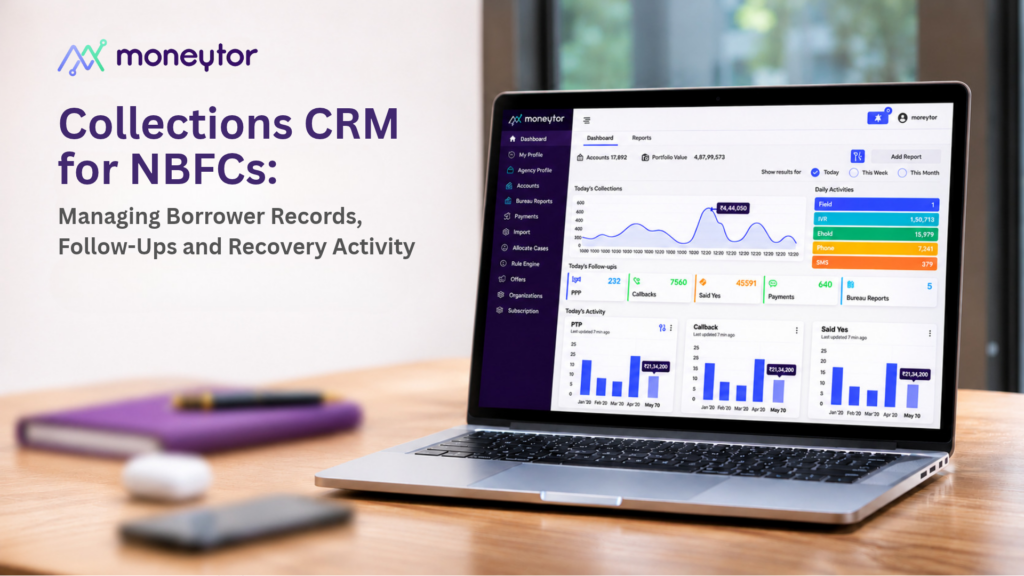
A collections CRM for NBFCs is the record of the borrower during recovery. It shows who the customer is, which loans are in the mandate, what was promised, which message or call happened, and what is due next. An NBFC collections management system that cannot answer those questions from one screen leaves the team working from memory and from side inboxes.
Loan collections CRM is not a general sales CRM with a collections label. The objects that matter are the borrower, the loan, the follow-up and the recovery activity. Borrower follow-up management software earns its place when the next officer can continue the last conversation without asking the borrower to repeat it.
This guide is for NBFC collections and operations leaders evaluating that record. It stays on the CRM: the data on the borrower, the follow-up queue, and the activity history. Choosing a recovery partner, writing the workflow rules, and running a full platform tender are related decisions with their own tests. Features still vary by engagement. Ask to see each item on your own accounts before you treat it as included.
What belongs on the borrower record
The centre of a collections CRM for NBFCs is the borrower, with the loans hanging off that person. A useful record shows:
- Identity and the contact details your policy allows the team to use.
- Each in-scope loan: product, overdue amount, stage, and the last payment that has reached the case.
- The owner of the current follow-up.
- Promises, disputes, complaints and channel stops.
- The history of recovery activity, in time order.
- The next task, with a due time.
A borrower with two live loans should open as one person. If each loan is a stranger to the other, the NBFC will contact the same customer twice and store two versions of the same promise. The loan system remains the source of the amount due. The CRM is the source of the conversation and the task. When those two disagree, the screen should show the conflict, not hide it.
Access follows the job. The officer sees the borrowers they own. The supervisor sees the team. Someone who has left the NBFC loses the record the same day. Marketing lists and origination notes that are not needed for recovery do not belong on this screen.
Follow-up management
Borrower follow-up management software is the queue behind the record. Every open promise, callback, unanswered attempt and approval request is a follow-up with an owner and a due time.
Check these behaviours in a demonstration:
- A new overdue creates one follow-up, not one per channel.
- A promise moves the next follow-up to the promise date and pauses reminders until then, if that is your rule.
- A missed promise puts the follow-up back into the queue you named for that event.
- A callback uses the time the borrower asked for, inside the hours you allow.
- A complaint or a dispute parks the follow-up with the grievance owner and stops reminder tasks.
- A supervisor can see follow-ups due today, still open from yesterday, and sitting with no owner.
That queue is also how you judge staffing. Language, product and location splits matter for NBFCs whose books are spread across centres. A single national list that ignores those splits will look busy and still miss the borrower who needed a Kannada-speaking officer or a local visit.
Field follow-up and calling follow-up should land on the same borrower. The visit, the call and the next step are one history. The officer who visits needs an authorisation the borrower can recognise, and the CRM should show that the visit was logged.
Recovery activity on the record
Recovery activity is everything that touched the borrower, stored so a supervisor can reconstruct the week.
For each action, the loan collections CRM should be able to show the time, the channel, the person or the rule that sent it, the template, the result, and any reply. Channels that NBFCs commonly need in the record are SMS, email, WhatsApp, Telegram, calling and IVR. Only the ones you enable have to appear. A reply that stays on a personal handset is not activity the NBFC can supervise.
Contact rules are part of the record, not a side policy. Under the NBFC Responsible Business Conduct Directions, 2025, updated as on 1 July 2026, recovery calls on overdue loans other than microfinance are barred before 8:00 a.m. and after 7:00 p.m. Microfinance recovery has its own conduct section, including calls treated as harsh before 9:00 a.m. and after 6:00 p.m. From 1 January 2027, covered NBFCs move to the Third Amendment Directions, 2026, including contact between 8:00 a.m. and 7:00 p.m. unless the borrower has expressly agreed otherwise. The CRM should show the window that applied and should be able to hold messages when a complaint is open. Your compliance team confirms which paragraph binds each product.
Payments and settlements are activity too. A part payment, a cleared bounce and an authorised settlement should post to the loan on the borrower record, with a reference finance can match. The CRM can present a payment path. It should not let an officer type a concession your credit grid did not approve. Unmatched receipts belong in an exception list on the same system.
What to test in an NBFC collections management system
Use a scripted hour with your data, or with a sanitised book of the same shape. Score only what you see.
| What you open | What a pass looks like |
| One borrower, two loans | Both facilities, one history, one current owner |
| Contact details | Only the numbers and addresses your policy allows, with a stop respected |
| Follow-up queue | Due today, aged from yesterday, unassigned |
| A promise and a broken promise | The next task moves, then returns, without a second owner |
| Complaint | Reminders stop and a grievance task opens |
| One channel step | Template, send or failure, and the reply on the timeline |
| Payment | Receipt on the loan, or an exception if the reference breaks |
| Supervisor view | Activity and ageing for the team, traceable to borrowers |
| Exit | Notes, tasks and activity can be exported if you leave the CRM |
Ask who may edit the borrower, who may merge a duplicate, and how a mistaken merge is undone. Duplicate borrowers are common when the same customer arrives from a partner origination and from your own book. The rule for a match should be yours.
Connections matter because the CRM goes stale if it is typed by hand. The loan system should feed the amount due. Your SMS, WhatsApp, voice or payment providers should feed the activity, where you want to keep those providers. You do not need the internal design. You need the refresh timing, the owner of a failed sync, and a queue for records that did not match.
If the NBFC is in the middle layer or above and the CRM is hosted by the vendor, read the IT-outsourcing provisions in the NBFC Managing Risks in Outsourcing Directions, 2025. The NBFC remains responsible for customer information a provider holds. Base-layer duties are narrower. Confirm your layer. Skip certification badges unless your security team has the current document and accepts its scope.
How Moneytor’s CRM fits an NBFC collections team
Moneytor provides a collections platform NBFCs can use as the working CRM for recovery: the borrower, the loans, the follow-ups and the activity. That is the product to evaluate against the script above. Some NBFCs also ask Moneytor to operate part of a book. The operating scope is separate. It does not fill gaps in the record.
Bring two products, a customer with more than one loan, a complaint, and a payment that should post. What is on screen in that session is the set to discuss. Do not assume every NBFC client has every channel or every queue.
Where the engagement includes them, the platform can support:
- Central borrower and loan account management, so the officer opens one person and each in-scope loan, with status, owner and history.
- Borrower follow-up management through allocation and task tracking: due work, aged work, and work with no owner, including calling and field steps that are in scope.
- Rule-based workflows that create the next follow-up from events you define, such as a new overdue, a broken promise or a hold, and that wait where you require an approver.
- Recovery activity on SMS, email, WhatsApp, Telegram, calling and IVR, using templates you approve, with the attempt, the failure and the reply on the borrower timeline, inside the hours for that product.
- Response tracking for promises, disputes, complaints and channel stops, visible to the next officer.
- Digital payment and settlement activity for amounts you have authorised, stored against the loan for reconciliation.
- Operational reporting a supervisor can open from a team total down to borrowers and follow-ups.
- Connections to communication and payment providers, including providers the NBFC already uses, where that feed is part of the design.
This is the difference from a conventional agency update. An agency can send a summary of calls. A collections CRM for NBFCs is the record your own supervisors open. Moneytor does not take your credit policy or your regulatory duty. Commercial terms and the fields you will actually use are agreed for your institution.
To run the script, use moneytor.in or contact@moneytor.in and ask for that working hour on your sample borrowers.
Frequently asked questions
What is a collections CRM for NBFCs?
It is the system of record for recovery conversations: the borrower, each in-scope loan, the follow-up, and the activity history. The loan system still holds the official balance. The CRM holds what the team did and what happens next.
How is a loan collections CRM different from a sales CRM?
A sales CRM tracks leads and applications. A collections CRM tracks overdue loans, promises, complaints, contact attempts and payments. Fields, permissions and the daily queue are built for recovery supervision.
What should borrower follow-up management software show?
Follow-ups due today, follow-ups still open from yesterday, and follow-ups with no owner, split in the way you staff the book, such as product, language or location. A promise, a broken promise and a complaint should each move that queue in a way you can predict.
Which activity must sit on the borrower timeline?
The time, channel, actor, template and result of each SMS, email, WhatsApp, Telegram, call or IVR that you use, plus the reply, the promise, the complaint and the payment. A channel you have not enabled does not need to appear. A channel you have enabled must not live only on a personal phone.
Can the CRM hold microfinance and other NBFC loans in one place?
Yes, if the contact rules differ by product. Microfinance and other overdue loans do not share the same calling window under the current NBFC directions. The record should show which rule applied. Re-check that setup before 1 January 2027, when covered NBFCs move onto the amended recovery section.
How should the CRM relate to the loan system and to message providers?
The loan system feeds what is due. Message and payment providers feed what was sent and what was received, if you keep those providers. Agree the refresh, the owner of a failure, and the list of borrowers or payments that did not match.
Does a collections CRM replace a collection agency?
The CRM is the record. An agency is a team that may work cases under your mandate. Your own officers can use the CRM. A partner can use it if your supervisors see the same borrower history. Evaluate the record and the team as separate scopes.
How can an NBFC review Moneytor as a collections CRM?
Contact Moneytor through moneytor.in or contact@moneytor.in. Ask to open one borrower with two loans, a follow-up queue, a held complaint and a posted payment. Treat the screens you are shown as the scope to write into the agreement.
Conclusion
A collections CRM for NBFCs is fit for the book when one borrower record carries every in-scope loan, every follow-up has an owner and a due time, and recovery activity can be read in order by a supervisor. Payments, stops and complaints belong on that same record.
Moneytor offers NBFCs that CRM as part of its collections platform, with account history, follow-up tracking, rule-based next steps, multichannel activity, response and payment history, reporting, and provider connections, scoped to the engagement. Run the working hour on your borrowers before you adopt the record.