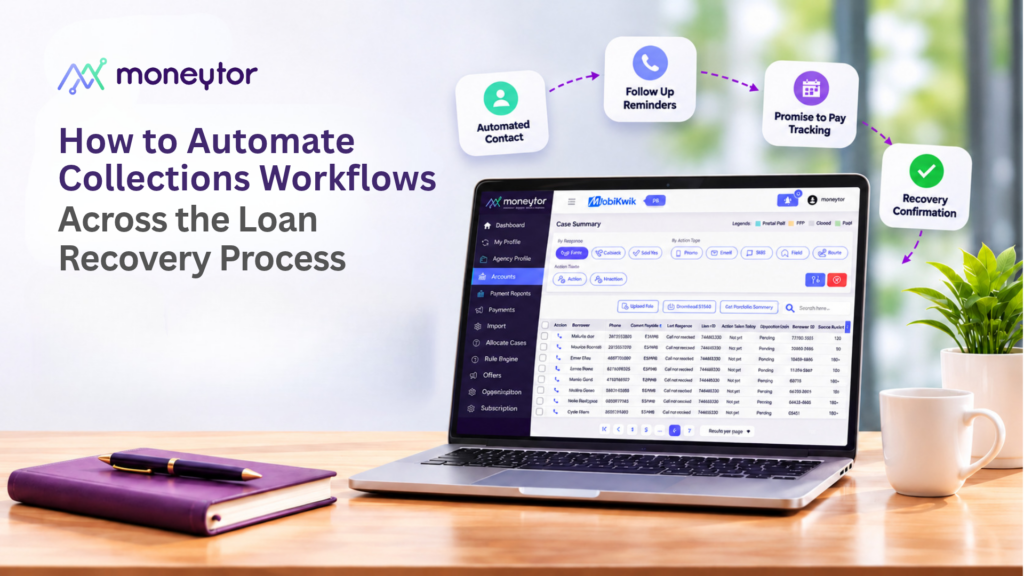
Collections workflow automation is the set of rules that move an overdue account from one step to the next. A new arrears item becomes a task. A kept promise closes that task. A broken promise opens another. An approved reminder goes out. A complaint stops the path.
Debt recovery process automation is useful when the rule is the one your credit and collections policy already uses. It is a poor fit when the system is free to choose a concession, ignore a complaint, or contact a borrower outside the hours you are allowed to use. Automated collections workflows should make the routine path consistent and leave the reserved decisions with a named person.
This guide is for heads of collections and policy owners at banks, NBFCs and other lenders. It shows how to design the path across the loan recovery process and how collections task management keeps each step owned. It does not replace a software tender, a vendor scorecard, or a card-statement playbook. Anything a platform can do still depends on what that lender has switched on.
What a collections workflow is
A collections workflow is the agreed path for one kind of account. The path names the event, the next task, the channel if a message is allowed, the owner, and the event that ends the task or sends the case somewhere else.
Typical events in a loan book include:
- A new overdue or a bounced instalment.
- No answer, or a request to call back.
- A promise to pay, then either a payment or a broken promise.
- A dispute or a complaint.
- A request for a settlement or hardship review.
- A move into a later stage that your policy treats differently.
- A payment that clears the overdue amount, or a payment that does not match the loan.
Collections task management is how those events become work someone can see. Each task has an owner, a due time, and a result. A workflow without tasks is a diagram. A task list without rules is another manual queue.
Where to automate, and where to stop
Map the recovery process before you turn a rule on. Split every step into three types.
The system may do it. Create the case, set the stage, assign the queue, schedule the next follow-up, send a template you have approved, and write the send or the failure onto the case. These steps are repetitive and already decided.
The system may prepare it, and a person finishes it. A collector records the promise. A supervisor releases a case that was on hold. An officer checks that a field visit is allowed. The workflow can open the task and attach the history. It should not mark the task done.
The system must wait. Settlement amount and tenure, hardship, any talk of possession, and the decision to lift a complaint hold stay with the approver in your grid. Debt recovery process automation that takes these decisions is outside a sound design.
Write the split down by product. A short-tenor consumer loan and a secured loan do not share one path. A borrower with two loans needs a rule so the second path does not start a second conversation the same morning.
A path across the recovery process
Use one path as the model, then vary it by product and stage. The point of collections workflow automation is that every account of the same type takes the same path unless a stated exception applies.
Intake
The loan system, or the file you trust, creates or updates the case with the identifier, the amount due, the product and the stage. If the balance refreshed overnight, the task uses the new balance. If the refresh failed, the case goes to an exception list and does not enter the contact path.
First task
The rule opens one task and gives it an owner or a queue, using product, stage, language or location. Collections task management starts here. Unassigned cases are visible before anyone contacts a borrower. Two owners on one case are an error, not a backup plan.
Contact step
If your policy allows a message, the rule sends it on a channel you have enabled. SMS, email, WhatsApp, Telegram, calling and IVR can each be a step. Each send uses your template. The case stores the attempt, a failure, and any reply. A second channel starts only if the path says so, after the wait you set, and only if the first step did not already get a promise, a payment or a stop.
Hours sit in the rule. Covered commercial banks currently restrict recovery calls before 8:00 a.m. and after 7:00 p.m. on overdue loans other than microfinance, under the Commercial Banks – Responsible Business Conduct Directions, 2025, updated as on 1 October 2026. NBFCs follow the NBFC Responsible Business Conduct Directions, 2025, updated as on 1 July 2026, and microfinance has a tighter window in those directions. From 1 January 2027, covered banks and covered NBFCs pick up the amended contact rules, including 8:00 a.m. to 7:00 p.m. unless the borrower has expressly agreed otherwise. See the bank Fourth Amendment and the NBFC Third Amendment. Build the window as something compliance can change without rewriting the whole path.
Response
The reply updates the case and chooses the next task.
- A promise creates a task dated to that promise and pauses further reminders until the date, unless your policy says otherwise.
- A callback creates a task at the time the borrower asked for.
- No contact creates the next attempt only up to the number and spacing you set.
- A dispute or a complaint puts the case on hold and opens a task for the team that owns grievances. Reminders stay off until that team releases the case.
- A stop on one channel removes that channel from later steps.
Payment and settlement
A payment path can offer the overdue amount or a part amount your policy allows. When the receipt matches the loan, the workflow closes the contact tasks and records the result. When the receipt does not match, it opens an exception task and does not keep calling the case as unpaid.
A settlement is a branch, not a default ending. The workflow can open the request and show the history. It sends an offer only after the approver has set the terms. The agent does not get a field in which to type a discount the policy does not allow.
Later stage and exit
If the case crosses a stage boundary, the rule moves it to the queue you named for that stage and closes the early-stage tasks. If you work with an external team on that stage, the handoff is a task with a time, and your supervisors can still see the case. When the overdue amount is cleared, or the account leaves the mandate, open contact tasks end and the history stays available for review.
How to keep automated collections workflows under control
A workflow is fit to run when you can answer these questions for every product.
- Who may edit the rule, and where is the change recorded?
- How do you test a new rule on sample loans before it touches the live book?
- What is the maximum number of attempts, on which channels, in how many days?
- Which events force a hold with no further messages?
- Which events require an approver, and what happens if they do not act by the due time?
- What does the supervisor see each morning: unassigned tasks, tasks past due, holds, and failed sends?
Review a sample of cases each week. Look for a path that looped, a message that went during a hold, and a task that no one owned. Debt recovery process automation improves when those samples change the rule, not when the diagram stays as it was on the day you drew it.
Incentives and targets sit outside the workflow, but they affect it. A task design that rewards sheer attempt volume will push contact past the limit you set. Align the task standard with your conduct rules. Covered banks and NBFCs are expected to keep recovery incentives from driving harsh contact. The 2027 amendments say this directly for the institutions they cover.
What the lender still configures
The platform can run the path. Your team still owns the content of the path.
- Stages and the event that moves an account between them.
- Templates, languages and the channel order.
- Attempt caps and quiet hours.
- The approval grid for settlements and other reserved acts.
- Which communication and payment providers are in the path, and who clears a failed send or an unmatched receipt.
If some channels use your providers and some use the platform provider’s, write that split into the workflow note so operations knows who fixes a failure the same day.
How Moneytor runs this kind of workflow
Moneytor provides a collections platform on which lenders can run rule-based recovery paths. The workflow is the part to look at in this kind of review: what creates a task, what sends a message, what waits for a person, and what a supervisor can see. Some institutions also ask Moneytor to work a segment. That operating scope is separate from the rules themselves.
Bring one product, a broken-promise example, a complaint you want held, and a settlement you refuse to let an agent set. What runs in the session is the scope to agree. The items below are not switched on for every client.
Where the engagement includes them, the platform can support:
- A case record for the borrower and each in-scope loan, so the workflow reads one history.
- Rule-based workflows and automation for intake, stage moves, reminders and broken promises, with holds for complaints and for approvals you reserve.
- Collections task management through allocation and follow-up tracking: an owner, a due time, and an ageing view for work that slipped.
- Automated steps on SMS, email, WhatsApp, Telegram, calling and IVR, limited to templates and hours you set, with the attempt and the reply stored on the case.
- Response tracking so a promise, a dispute, a complaint or a stop chooses the next task.
- Digital payment and settlement workflows that post an authorised amount to the case and leave concession terms with your approver.
- Activity reporting on tasks created, tasks overdue, holds, sends, failures and payments.
- Connections to communication and payment providers you already use, where that connection is part of the design, so a failed step is visible to the person who must clear it.
Moneytor does not replace your policy or your regulatory duty. Commercial terms and the live rules are agreed per institution. To test a path, use moneytor.in or contact@moneytor.in and ask to watch one account move from intake through a hold and a posted payment.
Frequently asked questions
What is collections workflow automation?
It is the use of rules to move an overdue account through agreed steps: create the task, assign it, send an approved contact, record the reply, and open the next task or a hold. People still handle the decisions you reserve.
Which recovery steps are reasonable to automate?
Case creation, queueing, scheduling the next follow-up, and sending a template you have approved are the usual automated steps. Settlement terms, complaint release, hardship and possession talk stay with a named approver.
How does collections task management fit the workflow?
Every step that needs a person or a check becomes a task with an owner and a due time. Supervisors use the overdue-task list to see breaks in the path. A workflow chart that does not produce tasks will not change the floor.
Can one workflow cover every loan?
Use one design method, then a path per product and stage. Secured loans, microfinance and early-bucket unsecured loans do not share contact rules or approval limits. A borrower with two loans needs a rule so both paths do not contact them at once.
How should messages and calls be limited?
Cap attempts, honour a stop request, and keep a complaint on hold with reminders off. Set quiet hours from the directions that apply to your institution, and make the hours a setting compliance can change. From 1 January 2027, covered banks and NBFCs should re-check the amended contact rules before the paths keep running.
What happens when a payment arrives?
If it matches the loan, contact tasks close. If it does not match, an exception task opens and the case leaves the ordinary calling path until someone clears the reference. The workflow should not keep treating a paid account as unpaid.
Does automation replace collectors?
No role disappears by default. Automation removes repeat administration and standardises the next step. Collectors and approvers still record outcomes and take the decisions on the reserved list. A partner team, if you use one, should work the same tasks you can see.
How can a lender test workflows on Moneytor?
Contact Moneytor through moneytor.in or contact@moneytor.in. Ask to run a sample loan through intake, an approved reminder, a complaint hold and a payment. Treat the rules you are shown as the set to confirm in the agreement.
Conclusion
Collections workflow automation helps the loan recovery process when every routine step has a rule and every reserved step has a person. Intake, tasks, approved contact, responses, holds, payments and stage moves should be visible to the supervisor who owns the queue.
Moneytor can run that kind of path for lenders, with case records, rule-based workflows, task allocation, multichannel steps, response tracking, digital payment and settlement, activity reporting, and provider connections, scoped to the engagement. Walk one account through the path before you turn a rule on for the live book.