A debt collection agency for banks should be appointed on evidence, not on a recovery claim in a pitch. Bank collections vendor evaluation asks whether the firm can work the segment you will actually assign, follow your conduct rules, and show your team the case, the contact, the reply and the payment.
Third-party debt collection adds people and, in a current programme, a system those people work in. Debt collection partners for banks that only return a monthly total leave the bank unable to supervise the work it remains responsible for. The evaluation should cover portfolio fit, staff controls, and the collections record: borrower and account, allocation, approved channels, responses, digital payments and reports.
This guide is for heads of collections, vendor management, risk and compliance at commercial banks that have already decided a segment will sit with an outside party. Choosing the operating model, evaluating card-statement workflows, and selecting an NBFC recovery partner are separate decisions.
What a bank collection agency is
A bank collection agency is a firm the bank engages to help recover overdue dues on a defined book. The book might be a personal-loan bucket, a card segment, a region or a set of accounts past a stated number of days. The bank names the accounts, the actions and the channels. The agency works inside that mandate.
From 1 January 2027, covered commercial banks will use a wide definition under the Commercial Banks – Responsible Business Conduct Fourth Amendment Directions, 2026. A recovery agency is any outside party engaged to assist recovery of dues from a borrower in default, including possession of security. A business correspondent who does that work is included. The job title in the contract does not decide the point. Until that date, use the same practical test: if the firm or its people contact the borrower for you, evaluate them as a recovery counterparty.
A capable partner brings collectors and a working record. Depending on the proposal, that record can include the borrower and each in-scope account, the owner of the case, the next action, the message or call, the borrower’s response, and a payment or an approved settlement. Confirm which of those are in the offer. They are not identical for every client of every firm.
What to decide before you open a bid
Vendor evaluation goes faster when the bank writes the assignment first.
- Segment. Product, days past due, secured or unsecured, language, and anything already with legal, a complaint team or a stressed-asset unit.
- Actions that stay inside the bank. Settlement terms, hardship, possession and the release of a complaint hold are common examples.
- Channels. Which of SMS, email, WhatsApp, Telegram, calling and IVR are allowed, and who approves templates.
- Volume and calendar. What the queue looks like around salary dates and bounce cycles, not the average day.
- Evidence standard. What “good” means in the pilot: data match, queue ageing, complaint rate, and payments that reconcile. Leave headline recovery rates out of the standard unless you have defined the formula yourself.
Send that note to every bidder so the proposals describe the same job.
Evidence to collect before a shortlist
Ask each debt collection partner for banks for documents, then check them.
Portfolio fit. A description of books like yours: product, bucket, ticket size, language and whether contact was by phone, message, field or a mix. References you can call. A performance number only counts with the period, the products included, the formula and the accounts left out.
People. How agents are hired, checked, trained and removed. Under the Commercial Banks – Responsible Business Conduct Directions, 2025, updated as on 1 October 2026, recovery agents for covered banks are expected to be trained and to hold the IIBF debt-recovery-agent certificate. Ask for a sample of certificates and for what happens to an uncertified person. The 2027 amendment keeps a certification requirement for recovery agencies. Do not assume a transition period. Confirm the text that applies on your signing date.
Conduct file. The code of conduct, the last quarter of complaints, two corrected failures, and how fast an agent or a channel can be stopped. Contracts must not push agents toward harsh methods. Current directions prohibit intimidation, harassment, public humiliation, inappropriate messages, threatening or anonymous calls, false statements, and recovery calls before 8:00 a.m. or after 7:00 p.m. on overdue loans other than microfinance. Calls with recovery agents are to be recorded, and the customer told. From 1 January 2027, covered banks limit contact and visits to 8:00 a.m.–7:00 p.m. unless the borrower or guarantor has expressly agreed otherwise, and they must publish an up-to-date list of recovery agencies.
Data and exit. The fields the agency needs, the fields it must not receive, who else can see them, and how cases, notes and payment references come back if you end the contract.
Drop firms that will not show these materials. A polished presentation is not a substitute.
What to test in the working system
Third-party debt collection is supervisable when your managers can open the case. Book a working session on a sample of your accounts, or on a sanitised book with the same shape. Score what you see.
Central borrower and account record. The borrower, each in-scope loan or card, the overdue position, the owner and the history appear together. A customer with two products is one person, so the teams do not double-contact.
Rule-based workflows. The next step follows your grid: a new overdue, a broken promise, a dispute, a complaint hold, a case that must wait for your approval before any settlement talk. Ask who changes a rule and how you test the change before it reaches borrowers. Automation can move the routine step. It stops where you have reserved the decision.
Allocation and follow-up. Cases are given to named people by language, bucket or location. You can see what is due today, what was skipped and what has aged. That view is how you test staffing, not a headcount slide.
Channels and responses. For each channel in the proposal, among SMS, email, WhatsApp, Telegram, calling and IVR, you see your template, the send, a failure, and the borrower’s reply on the account. A request to stop a channel blocks the next message. Hours follow the rule for that product.
Payments and settlements. A part payment and a settlement you have already authorised post to the case with a reference your loan system can match. The agency does not set the concession.
Activity reports. You can open allocated accounts, attempts, contacts, promises, payments, settlements waiting for approval, and complaints, then trace a total to the rows. Agree the meaning of “recovered” before the pilot.
Your communication and payment providers. The proposal states whether messages and collections run through providers you already contract, through the agency’s providers, or both. You know who owns the template, who clears a failed send or a failed receipt, and how fast that failure shows up.
If the session is only slides, treat the technology section of the score as incomplete.
How the contract keeps the bank in control
The Commercial Banks – Managing Risks in Outsourcing Directions, 2025 state that outsourcing does not reduce the obligations of the bank, its board and senior management. The bank remains responsible for the provider’s actions, including recovery agents, and for customer information the provider holds. It has to retain control of the activity.
Use the evaluation to fill the contract, not the other way round.
- Due diligence and the right to re-check staff.
- Need-to-know access and notice of a security incident.
- Audit access to cases, recordings and complaints.
- A grievance path that reaches a named bank officer. Current directions restrict sending a case to an agency while a borrower complaint is open, with a narrow exception where the bank has evidence that complaints are being used to stall recovery. From 2027, recovery communications for covered banks must carry the bank’s grievance contact, and the borrower must be told before an in-person visit.
- Incentive language that does not reward harsh contact.
- Exit: return of cases and history in a stated format and time, and removal of access.
Small finance banks, payments banks, regional rural banks and local area banks should confirm which conduct and outsourcing directions apply to them. The commercial-bank set described here excludes those categories from the 2027 amendment’s scope.
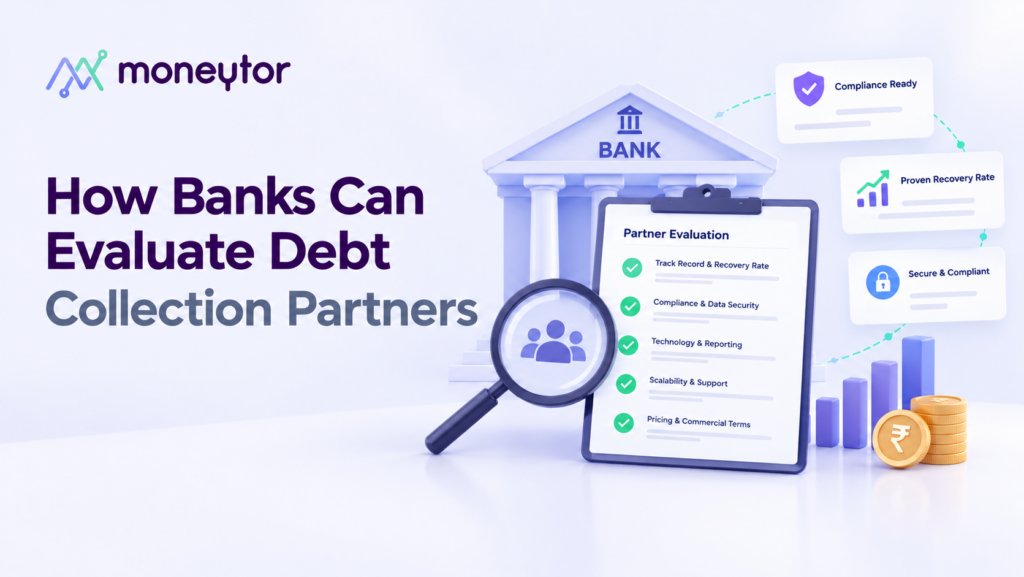
A scorecard for bank collections vendor evaluation
Use one sheet for every bidder. Weight conduct and case visibility at least as heavily as a claimed collection result.
| Test | Evidence that passes |
| Segment fit | Worked examples and references for your product and bucket |
| People | Training records, IIBF certificates for agents who will touch the book, and a removal process |
| Conduct | Complaint samples, recorded-call practice, hours, and a way to stop an agent |
| Case record | Borrower, accounts, owner and history in one view |
| Rules | Your grid, including complaint holds and approvals that stay with the bank |
| Channels | The channels in this proposal, your templates, replies stored on the case |
| Money | Payments and authorised settlements that reconcile |
| Reporting | A total that opens to accounts |
| Providers | A clear split between your communication and payment providers and theirs |
| Data and exit | Minimum fields, incident notice, and a tested handover |
| Price | What the fee includes and how a disputed amount is closed |
Compare bidders on the same sample and the same period. File the sheet. Audit and the board will ask for it.
References, pilot and the decision to stop
Call two references and ask what the queue looked like in a heavy week, how complaints were handled, and whether they could open a case without asking the agency. A reference that can only discuss a percentage is a weak reference.
Pilot one segment for a defined period. Before it starts, write the baseline: accounts loaded, match rate to your loan system, share of cases with an owner, ageing past your standard, complaints per thousand accounts, and payments that reconcile. Review those measures on a fixed date. Expand only if they hold. End or re-scope the pilot if case history is missing, contact breaks the hours or the script, or money does not match.
Commercial terms
Service fees, account-based charges and outcome-linked fees all exist in the market. None is the default for a bank collection agency, and none should be assumed for a named firm. Write the price against the segment, the channels, the reports and the connections. Then add the cost of your own supervision. A lower quote that needs a larger internal team to reconstruct the work is a higher total.
How Moneytor stands up to this evaluation
Moneytor works with banks on collections for stressed retail credit. For a vendor review, the relevant fact is that collection activity can run on a platform your team can open, alongside the people doing the contact. That is a different offer from a firm that takes a file and returns a periodic summary.
Bring the segment note from the start of this guide to the first meeting. Moneytor should be scored on the same sheet as any other bidder: fit, conduct, the case you can see, and the fee. Scope and commercial terms are agreed for your bank. A channel or a workflow that is not in the proposal is not part of the offer.
Where the agreed scope includes them, the platform can support:
- One record of the borrower and each in-scope loan or card account, with status, owner and history.
- Workflows from your rules, including a path for routine overdue steps and a stop for complaints, disputes and settlements that need your approval.
- Allocation and follow-up tracking so supervisors can see due, done and aged work.
- SMS, email, WhatsApp, Telegram, calling and IVR on your templates, with sends, failures and replies on the account, inside the hours that apply.
- Response tracking for promises, disputes and complaints.
- Digital payment and settlement workflows for amounts you have authorised, with a reference for reconciliation.
- Activity reports your vendor manager can trace to accounts.
- Connections to communication and payment providers, including providers you already use, where that is part of the design.
Moneytor does not replace the bank’s policy, approval authority or regulatory duty. Results depend on the segment and the measures you set. Teams running this evaluation can use moneytor.in or contact@moneytor.in and ask to be taken through the same demo script you will use with other bidders.
Frequently asked questions
How does a bank evaluate a debt collection agency?
Write the segment and the evidence standard first. Then compare fit, people, conduct, the case record, channels, payments, reports, data exit and price on one scorecard. Use a working session and a pilot, and keep the sheet.
What should a bank collection agency show besides collectors?
A record your managers can open: borrower, accounts, owner, the rule that set the next step, the message or call, the reply, and the payment. Confirm which channels and reports are in that proposal.
Which channels are reasonable to allow?
SMS, email, WhatsApp, Telegram, calling and IVR can all be in scope if you approve the templates and the platform stores the reply. Hours, recording and a stop on request still apply. The channel does not relax the conduct rules.
Do business correspondents need the same evaluation?
If they recover dues for the bank, evaluate them as recovery counterparties. From 1 January 2027, covered commercial banks must treat a business correspondent who does that work as a recovery agency.
Who is responsible for third-party debt collection?
The bank, its board and senior management. Outsourcing does not move the duty. The contract needs audit access, a grievance path, incident notice and a way to take the cases back.
How should banks compare fees?
List what the fee covers and how a disputed amount is closed. Compare that with the supervision your own team will still do. Do not treat any one fee style as the industry standard or as a particular firm’s standard without a written offer.
What should change in agency contracts before 1 January 2027?
For covered commercial banks, prepare for the wider recovery-agency definition, a public list of agencies, visit notices, grievance details on communications, IIBF certification, incentive controls and the 8:00 a.m. to 7:00 p.m. window unless the borrower has agreed otherwise. Confirm that your bank is in that set.
How can a bank include Moneytor in a vendor review?
Contact Moneytor through moneytor.in or contact@moneytor.in with the segment, the actions you will keep, the channels you allow and the scorecard you are using. Ask for the same working session you require of every other bidder.
Conclusion
A debt collection agency for banks is fit to appoint when your team can see the work and stop it. Portfolio evidence, certified and supervised people, a case record, approved channels, payments you can reconcile, and a contract that preserves the bank’s control are the tests that matter.
Moneytor can be put through that same review. Where the engagement includes them, the collections platform covers account management, rule-based workflows, allocation, multichannel contact, response tracking, digital payment and settlement, activity reporting, and connections to communication and payment providers. Speak to the institutional team with your segment note and your scorecard.