A credit collections management system is the place a lender works overdue credit accounts together. Credit cards, personal loans and other retail credit facilities stop living on separate lists. The officer opens the customer, sees each account that is in arrears, and records the next action once.
Credit collection software earns that role when overdue credit account management is central: one owner, one history, one set of rules for what may happen next. A credit collections platform that only stores a copy of the arrears file, while calls and payments sit elsewhere, leaves the book split.
This guide is for heads of collections and portfolio managers at banks and NBFCs. It explains how the system holds overdue credit accounts and what teams should be able to do from that record. Card-statement design, a full software tender, and a digital-transformation plan are separate pieces of work. What a given deployment includes still depends on the agreement.
What the system centralises
Overdue credit account management breaks when each product team keeps its own queue. The card team calls in the morning. The personal-loan team messages in the afternoon. Neither can see the promise the other took.
A credit collections management system puts these objects in one record:
- The customer.
- Each in-scope credit account: card, personal loan, or other facility, with the amount overdue and the stage.
- The owner of the next action.
- Promises, disputes, complaints and channel stops.
- Messages, calls and payment attempts, in time order.
- The next task and its due time.
The card or loan system remains the source of the balance. The collections system is the source of the work. If the balance on the case and the balance on the host disagree, the screen should show that, and the account should wait out of the contact path until the figures are aligned.
Access follows the job. An officer sees the accounts they own. A portfolio manager sees the segment. A leaver loses access. Data that is not required to collect the overdue amount stays off the record. For credit cards, that limit is stricter: card issuers share card data with a service provider only when it is essential, and storage of card data stays with the issuer, under the Credit Card and Debit Card – Issuance and Conduct Directions, 2022, updated as on 7 March 2024.
How overdue accounts are managed on the platform
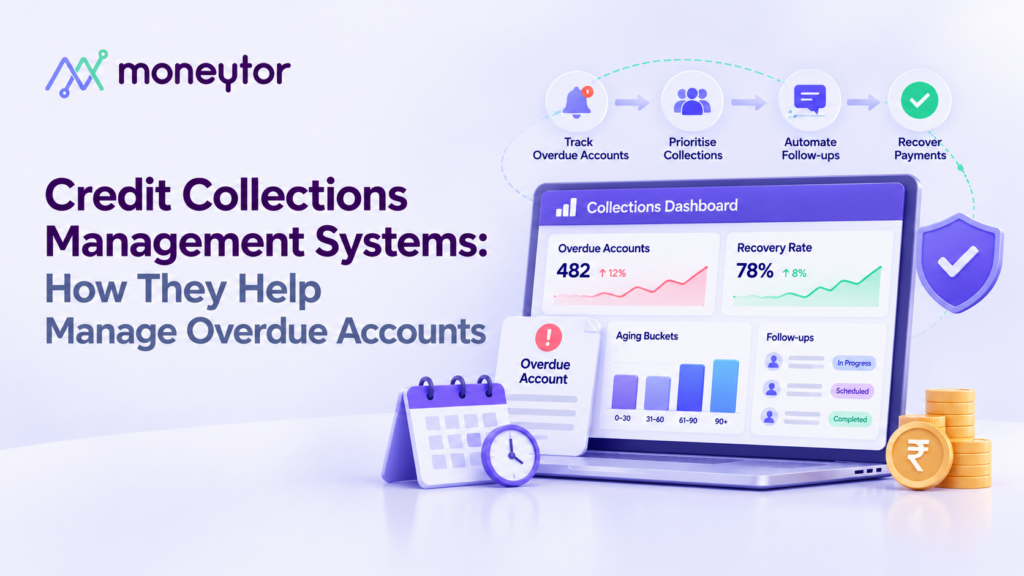
The daily control of a credit collections platform is a short loop.
Load. New and existing arrears arrive with an account identifier, product, amount due and stage. A customer with a card and a personal loan appears once. Two arrears do not become two strangers.
Route. Rules set the path your policy already uses. A fresh card arrears item, a bounced personal-loan instalment, a broken promise and a later stage do not have to share one script. They do have to be visible on the same customer. Automation may open the task or send a template you approved. It waits for a person where you reserve the decision, including a settlement or a hardship request. A complaint is recorded on the account. Treat a stop on later messages, including on a second product, as in place only after you have seen that workflow run.
Assign. Each open action has an owner. Portfolio managers can see work due today, work still open from yesterday, and work with no owner, split by product or stage if that is how the teams are organised.
Contact. SMS, email, WhatsApp, Telegram, calling and IVR can be steps on the account if you have enabled that channel and approved the template. The attempt, a failure and the reply sit on the customer, so the second product team does not repeat the first contact.
Resolve the money. A payment of the overdue amount, a part payment, or a settlement you have authorised posts to the account reference. An unmatched receipt becomes an exception. The case does not stay in the calling queue as unpaid.
Read the book. Overdue credit account management for a portfolio head is the segment view: accounts loaded, accounts with an owner, attempts, promises, payments, holds and mismatches, each of which opens to the underlying accounts.
Contact and conduct the system has to respect
Centralising the book does not loosen the contact rules. It makes them easier to apply once, across products.
Covered commercial banks currently bar recovery calls before 8:00 a.m. and after 7:00 p.m. on overdue loans other than microfinance, under the Commercial Banks – Responsible Business Conduct Directions, 2025, updated as on 1 October 2026. Card issuers also follow the credit card directions: recovery agents must be identifiable, communications must carry a senior officer of the issuer the cardholder can contact, and the issuer gives the cardholder the agent’s name and contact details when an agent is assigned. Confidentiality and a bar on harassment sit in those directions too.
NBFCs follow the NBFC Responsible Business Conduct Directions, 2025, updated as on 1 July 2026, including a separate microfinance window. From 1 January 2027, covered banks and covered NBFCs move onto amended recovery-agency rules, including contact between 8:00 a.m. and 7:00 p.m. unless the borrower has expressly agreed otherwise. See the bank Fourth Amendment and the NBFC Third Amendment.
On the system, that means a quiet-hour setting by product, a complaint recorded on the account, and a timeline a reviewer can read. A rule that then stops reminders on that account, or on every in-scope account of that customer, has to be confirmed in the workflow you are buying. Your compliance team confirms which direction binds each product.
What to look for in credit collection software
Use one working session on a customer who holds two credit products, or on a sanitised pair with the same shape. Mark only what you see as in this proposal.
| Check | What you should be able to do |
| Customer and accounts | Open one person and every in-scope card or loan, with stage and amount due |
| Conflict | See when the collections balance and the host balance differ, and hold contact |
| Follow-up | Find due, aged and unassigned work without exporting a list |
| Cross-product contact | See a promise or a stop on one account before anyone touches the second |
| Channels | Send only approved templates, and find the reply on the timeline |
| Payment | Post a matched receipt, or park an unmatched one off the calling queue |
| Settlement | Offer only terms an approver has already set |
| Portfolio view | Open a segment total down to accounts |
| Exit | Take the history with you if you leave the software |
If a partner team will work some accounts, they use the same record your portfolio managers see. The partner does not become a second, private book. Banks and NBFCs remain responsible for outsourced activity and for customer information a provider holds, under the bank outsourcing directions, 2025 and the NBFC outsourcing directions, 2025. Confirm the chapters that apply to your category, including IT outsourcing if the software is hosted.
Do not score the software on a recovery rate or a saving. Score it on whether overdue accounts are complete, current, owned and reconcilable.
How Moneytor supports central credit collections
Moneytor provides collections software that lenders use as a credit collections management system for overdue retail credit, including cards and loans placed in scope. Moneytor licenses the intellectual property as source code. The lender receives a licensed copy of the product source code and can adapt that copy to the technology environment it already runs: its loan and card systems, its communication and payment providers, and the products on its book. An operating brief, where Moneytor staff work a segment, is a separate contract.
The work the software takes off the floor is decisioning and the repetitive steps that follow a decision. Rules the lender sets read the account: product, stage, amount due, promise, time of day and whether a person has reserved the case. From that, the workflow chooses the queue, the owner pattern and the approved template. Automation then does the repeatable operations: open the task, assign it, send the template inside the hours for that product, write the attempt and the reply to the account, and park a payment that does not match. Officers spend their time on the accounts the rules hold for a person, such as a settlement or a hardship request. A complaint is tracked on the account, with an owner and a history. An automatic stop on later messages, including a stop across every product of that customer, is not part of this description. Confirm that behaviour with the product team before you treat it as available.
Bring a customer with more than one credit product, the rules you want the workflow to run without an officer, a complaint, and a payment that should post. What is shown is the scope to agree. Channels and products in the session are the ones in the offer.
Where the engagement includes them, the platform can support:
- Central borrower and account management for each in-scope card or loan, with status, owner and history.
- Collections decisioning that selects the next step from the lender’s rules on product, stage and account events.
- Automation of repetitive work so task creation, allocation, approved messages and the logging of attempts and replies run from those rules, and staff handle the cases the rules leave for a person.
- Rule-based workflows that differ by product and stage, and that wait for approval on settlements and hardship.
- Allocation and follow-up tracking so portfolio managers can see due, aged and unassigned work.
- Contact by SMS, email, WhatsApp, Telegram, calling and IVR, on templates you approve, with the attempt and the reply on the account timeline, inside the hours for that product.
- Response and complaint tracking on the account.
- Digital payment and settlement workflows for amounts you have authorised, with a reference for reconciliation and an exception path for a broken match.
- Activity reporting for the overdue credit book, traceable to accounts.
- Connections to communication and payment providers, including providers you already use, where that feed is part of the design.
- A licensed source-code copy the lender can adapt to its existing systems and collection strategies.
Moneytor does not take the lender’s credit policy or regulatory duty. Commercial terms, the source-code licence and the live accounts are agreed per institution. To test the central record, use moneytor.in or contact@moneytor.in and ask to open one customer, two products, a rule that sends the routine step, a logged complaint and a posted payment.
Frequently asked questions
What is a credit collections management system?
It is the system a lender uses to manage overdue credit accounts in one place: the customer, each card or loan in the mandate, the owner, the history and the next action. The host system keeps the official balance. The collections system keeps the work.
How does credit collection software help with more than one product?
It shows every in-scope account on the same customer. A promise, a complaint or a stop recorded on one account is visible before another team contacts the customer about a second account.
What should overdue credit account management include each day?
Accounts loaded, accounts whose balance does not match the host, follow-ups due, follow-ups with no owner, accounts on hold, and payments that did not match. Those lists are the control of the book.
Which channels can the platform use?
SMS, email, WhatsApp, Telegram, calling and IVR can sit on the account if you enable them and approve the templates. Quiet hours follow the product. A complaint is tracked on the account. Any automatic stop on later messages, including across products, should be demonstrated before you rely on it. The hours depend on whether the lender is a bank or an NBFC and on the product, including microfinance.
How are card data limits handled?
The collections record should carry what the team needs to collect the overdue amount. Card issuers keep card data, including transaction data, with the issuer unless sharing is essential and permitted. Confirm the fields with your card and information-security teams before a feed is switched on.
Can a partner work accounts in the same system?
Yes, if your managers see the same customer, the same tasks and the same history. A file that leaves and comes back only as a summary is not central management. The lender remains responsible for the partner’s contact and for the data the partner holds.
How should a lender judge the system?
Look for a complete customer, a current amount due, a single owner, contact that follows your rules, and money that matches. Do not treat the software as the source of a recovery rate.
How can a lender review this on Moneytor?
Contact Moneytor through moneytor.in or contact@moneytor.in. Ask to see the licensed source-code model, a rule that runs a routine contact step without an officer, complaint tracking on the account, and a payment posted to the right account. Treat that session as the scope to write down.
Conclusion
A credit collections management system helps lenders manage overdue accounts by making the customer the centre of the book. Each in-scope card or loan, each follow-up, each contact and each payment sits on that record, under rules the lender still sets.
Moneytor licenses that software as a copy of the product source code, so the lender can adapt it to the systems it already runs. In the agreed scope it also covers account records, collections decisioning, automation of the repetitive steps, allocation, multichannel contact, response and complaint tracking, digital payment and settlement, activity reporting, and provider connections. Open one multi-product customer and one automated routine step on it before you call the book centralised.